
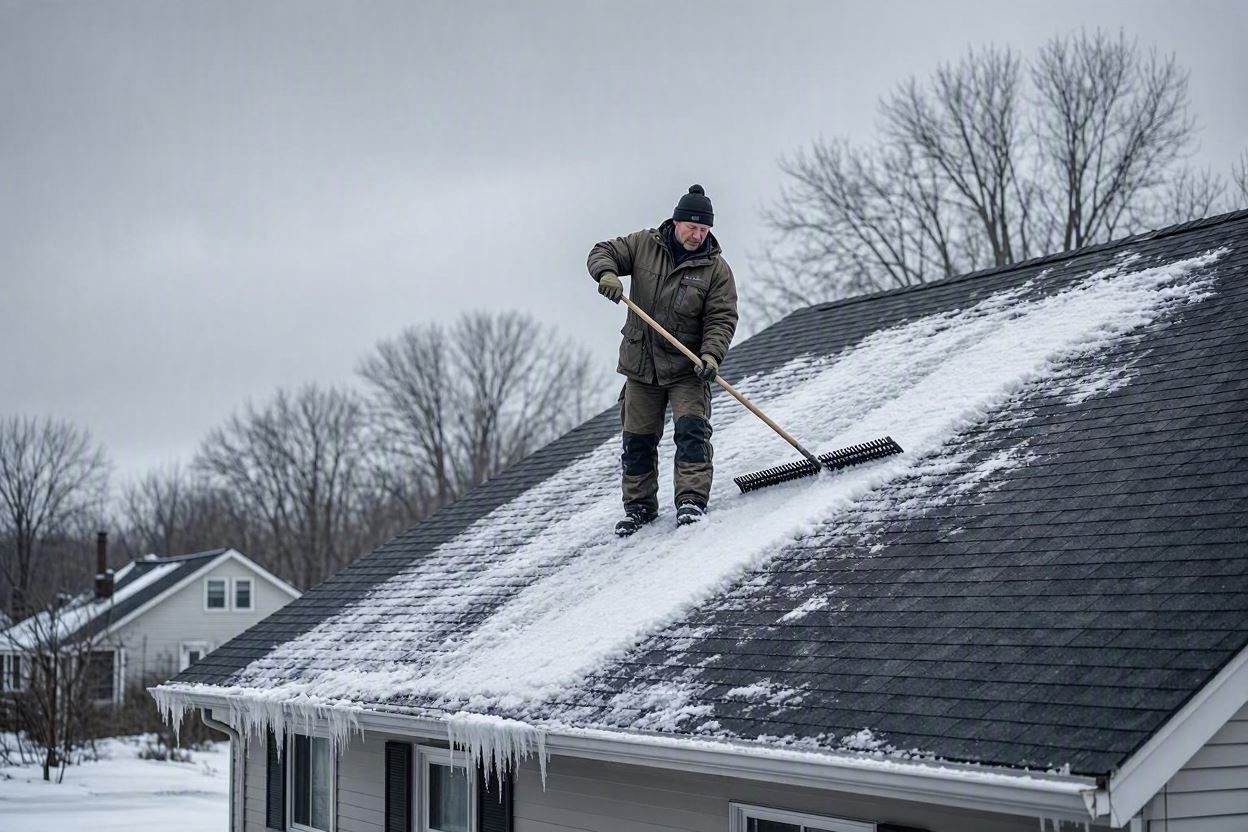
Most roofs in Orange County do not fail under snow. They fail under ice — the ridge of frozen melt that builds at the eaves after a thaw and forces water backwards, under the shingles, into the ceiling below. Here is how to tell the difference, and when raking it yourself stops being a good idea.
Snow load is rarely the emergency
A healthy, properly framed roof in the Hudson Valley is built for the snow our winters produce. What actually gets people into trouble is weight that has changed state: a foot of dry powder is light, but the same foot after a day of rain or a freeze-thaw cycle can weigh several times as much. If you hear new creaking, see doors that suddenly stick, or notice a sagging line in a ceiling, that is a structural conversation — not a raking job. Get everyone out from under it and call someone.
Ice dams: what is actually happening
Snow on the upper roof melts because heat is escaping from the living space below. The meltwater runs down to the eave — which is cold, because there is no heated room under an overhang — and freezes. Do that for a few days and you get a wall of ice with a pond behind it. Shingles are designed to shed water that runs down. They are not designed to hold back standing water, so it finds the nail holes and the laps and comes inside.
The tells, in order of how worried you should be:
- Long icicles along the gutter line. Pretty, and a warning.
- A thick band of ice at the eave while the rest of the roof is clear snow.
- Wet staining on the ceiling near an exterior wall, usually a corner.
- Water running down the inside of a window frame. That one is already a repair.
What you can safely do yourself
From the ground, with a roof rake, you can pull the first three or four feet of snow off the eave edge. That removes the fuel for the dam. Work sideways, keep the rake flat to the surface, and stand out of the fall line.
What you should not do
- Do not climb onto a snowy roof. Nothing on that roof is worth the fall.
- Do not chip at the ice with a hammer, a hatchet or a shovel. You will find the shingles under it, and the repair costs more than the removal would have.
- Do not throw rock salt on the roof. Sodium chloride stains, corrodes flashing and kills whatever is planted below the drip line.
- Do not run a pressure washer or a torch. Both have set houses on fire.
When to call us
Call when the dam is thicker than a few inches, when it has already pushed water inside, when the roof is too steep or too high to reach from the ground, or when there is a metal roof, a skylight or a solar array in the way. We clear it with low-pressure steam, which melts the ice without touching the shingle surface, and we rake the load off from the ground wherever the geometry lets us.
Ice dam already dripping into the house? Call 845-682-9536 — we answer Monday to Saturday, 7:00 AM to 6:00 PM.
The fix that stops it repeating
Ice dams are an insulation and ventilation problem wearing a roofing costume. Once the weather breaks, the permanent fixes are: air-seal the ceiling plane so heat stops leaking into the attic, top up the attic insulation, and get intake and exhaust ventilation balanced so the roof deck stays close to outside temperature. When a roof is being replaced anyway, a proper ice-and-water membrane at the eaves and up every valley is the cheapest insurance you will ever buy — it is a membrane that seals around the fastener, so even if water backs up it has nowhere to go.
Where we work
We cover Orange County, NY out of Greenwood Lake — Warwick, Monroe, Chester, Goshen, Tuxedo Park, Highland Falls, Woodbury and the rest of the county — plus Rockland and Westchester. Winter calls get priority when water is already inside.
Leave a Reply