
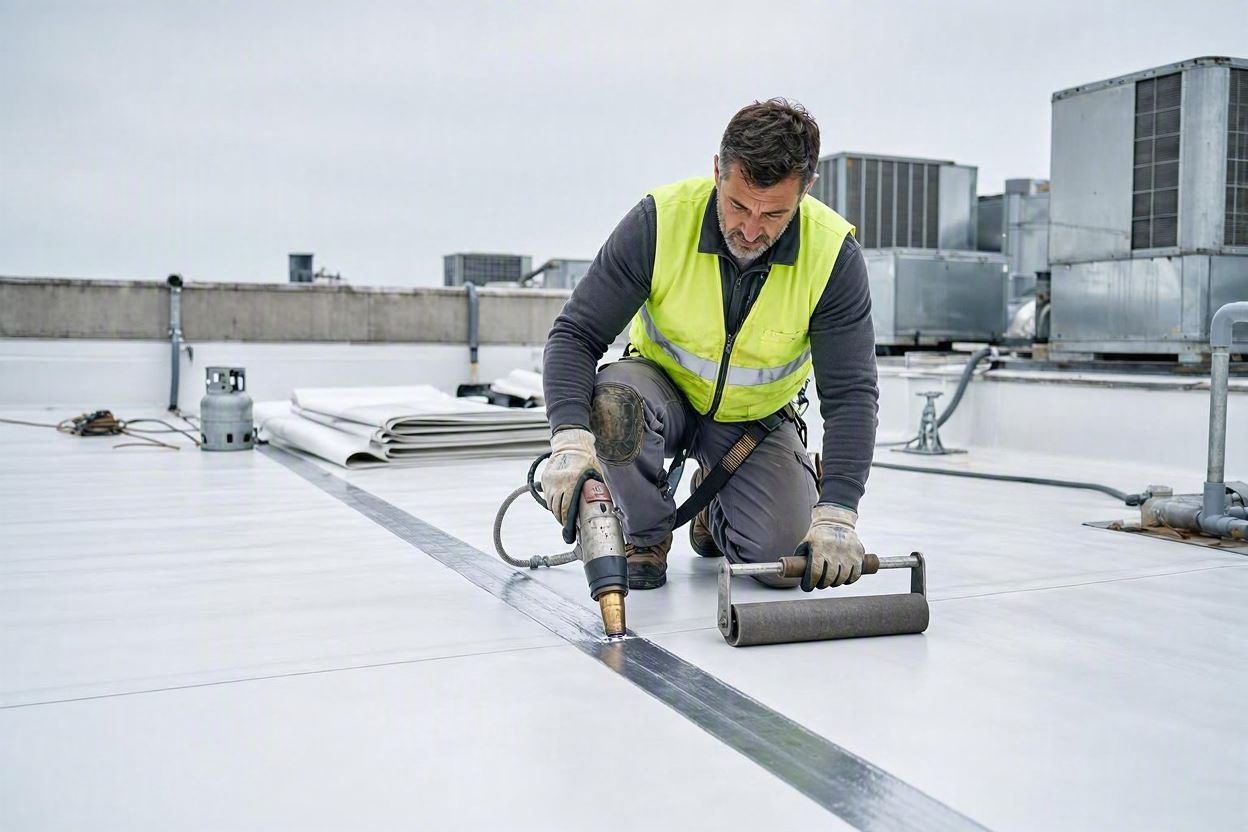
If your flat roof is at the end of its life, the real choice is usually between a white TPO membrane and a black EPDM rubber one. Both are good roofs. They fail for different reasons, and in a Hudson Valley winter that difference is worth understanding before you sign anything.
The short version
- TPO — a white thermoplastic sheet, hot-air welded at the seams. The weld fuses the two sheets into one piece of material. Reflects sun, so the roof and the space under it run cooler in summer.
- EPDM — a black synthetic rubber sheet, joined with adhesive seam tape. Very forgiving of movement and of complicated shapes. Absorbs heat, which is a drawback in July and an advantage in February, when snow slides off it sooner.
Seams are where flat roofs actually fail
Almost nothing goes wrong in the middle of a flat roof. It goes wrong at a seam, at a penetration, or at the edge. That is the single most useful thing to know when comparing quotes.
A hot-air welded TPO seam is a fused joint — done properly, the sheet will tear before the seam does. A taped EPDM seam depends on the adhesive and on how clean the surface was when it went down. Modern seam tapes are good, but they are a chemical bond, not a fused one. Ask any contractor how they test seams. On TPO the answer should involve a probe being run along every weld.
Which one suits a Hudson Valley building
Choose TPO if…
- The roof gets full sun and the space below it is conditioned — the reflectivity is real money on a commercial cooling bill.
- The layout is fairly simple: large open planes, a few curbs.
- You want the seam welded rather than taped.
Choose EPDM if…
- The roof is cut up with penetrations, odd angles and parapets — rubber is far easier to detail.
- Snow retention is a nuisance and you would rather the surface shed it sooner.
- The building moves: EPDM stretches and recovers better than any thermoplastic.
What actually drives the price
Anyone quoting a flat roof from the street is guessing. The number moves with:
- Tear-off versus recover. How many layers come off, and what the deck looks like underneath.
- Insulation. Whether you are adding tapered insulation to fix ponding — often the right call, and often the biggest line on the estimate.
- Penetrations. Every vent, curb, drain and skylight is a hand-detailed piece of work.
- Edge metal and drainage. The perimeter is where most leaks start.
- Access. Whether material can be craned or has to be carried.
Ponding water is the question to ask
If water is still standing on the roof two days after rain, neither membrane is your problem — the slope is. Recovering a ponding roof with a new membrane buys you a few years and the same conversation later. Tapered insulation costs more up front and solves it.
Flat roof leaking, ponding, or just at the end of its run? We will come out, measure, photograph it and email you an itemized price — 845-682-9536.
A note on permits
Roof replacement in Orange County is generally permitted work, and requirements differ by town. We pull the permit as part of the job and we confirm the specifics with your building department rather than assuming — that is the only answer anyone should give you in writing.
Leave a Reply